
📋 Observation Report
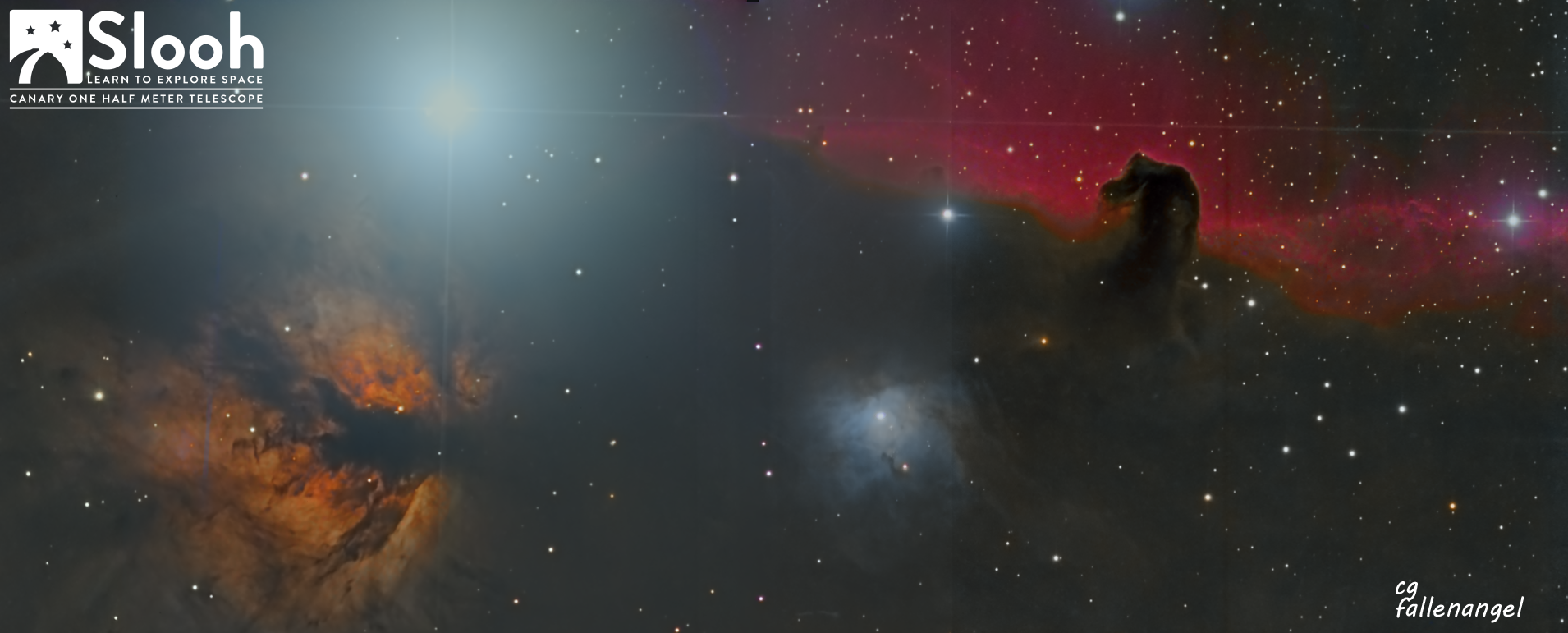
Horsehead Nebula Triology IÎ: Canary I 2×1 mosaic.
This 68.4 x 27.6 arcmin field CAT1 2×1 mosaic in Orion unveils emission, absorption, and reflection nebulae comprising a star forming area at ~400 pc distance including Horsehead (IC 434) and Flame Nebulae (NG 2024). I know they are very adjacent, so why not fancy both up in a mosaic.
Set against the glowing hydrogen curtain of IC 434, a dark cloud of cosmic dust rises in a distinct horse-shaped silhouette. Adjacent, the Flame Nebula (NGC 2024) blazes with intricate pillars lit by the massive star Alnitak (ζ Ori 50 Ori).
Furthermore the reflection nebulae NGC 2023 is shining in blue starlight. These structures all inhabit the vast Orion B molecular cloud, a rich and turbulent star-forming region. Within this field young stars, dark lanes, and glowing gases converge — a dramatic snapshot of stellar birth and cosmic sculpting.
Pixinsight processing 4+11+1xCAT1 session. Read on for detail description and annotated image.
In this mosaic of the Orion B molecular complex, massive star feedback becomes visible in multiple evolutionary phases. The O9.5 supergiant Alnitak dominates the radiation field, its ultraviolet flux ionizing the extended sheet of hydrogen designated IC 434. Against this bright emission screen lies Barnard 33, the Horsehead Nebula — not a single structure but a dense pillar within a larger filament. Its sculpted morphology traces ongoing photoevaporative erosion, with neutral cores that remain shielded from dissociation while outer layers sublimate into ionized gas. The result is a precise visual record of how molecular clouds are dispersed by the very stars they form.
To the east, NGC 2024 (the Flame Nebula) presents a different phase of the same process. Here dust density is high enough to obscure the embedded young stellar cluster in visible light; only in infrared does the stellar engine driving the emission become apparent. Instead of a silhouette against an ionization front, the Flame displays edge-on ionization and heavy attenuation — a reminder that star formation rarely occurs on the unobscured surfaces we most easily photograph.
The field also showcases the complementary role of reflection nebulae. NGC 2023, illuminated by the B1.5 star HD 37903, is among the brightest known reflection nebulae and sits adjacent to regions of active star formation with photodissociation fronts that emit strongly in the near-IR.
The full 1.46° × 1.78° field captures the interface between the Orion OB1 association and the L1630 (Orion B) molecular cloud, roughly 400 parsecs distant. This spatial scale reveals a feedback-regulated star-forming environment: ionizing radiation and stellar winds drive cloud fragmentation, excavating cavities while simultaneously compressing adjacent regions, triggering secondary collapse. In other words — the destructive forces of high-mass stars are also the agents of future stellar birth.
© 2026 cgfallenangel All rights reserved.