
📋 Observation Report
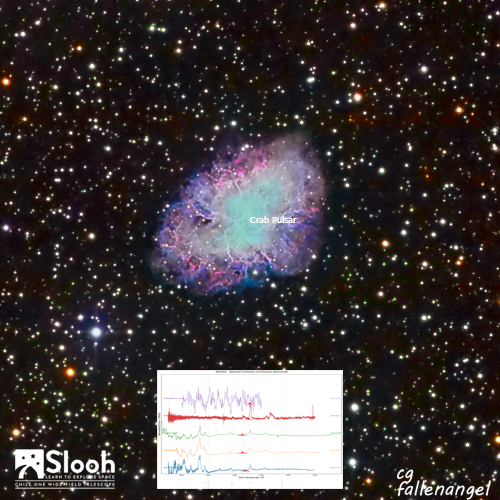
This is a virtual evolution observation report of supernova SN 1054, my SLOOH images and CAT4 spectra as well as using historical records of the supernova event and spectra of the recent supernova SN 2018zd. There’s consensus that SN 2018zd is of the same type and sub-type as SN 1054 was. To create a virtual evolution spectrum some early spectra of SN 2018zd simulate early SN 1054 spectra of the remnant of SN 1054, the 2026 Crab Nebula added. The supernova suddenly appeared out of nowhere as a brilliant “guest star” on July 4, 1054 but this was not a one-off personal observation. It was discovered during routine institutional observations and followed up by a formally recorded, long-term monitoring and recording campaign. Spectroscopy of course did not exist 1054, however sophisticated instruments measured brightness and position of the supernova. Spectroscopy bridges the 1054 accounts. PI 63xCAT1 M1, 132xCAT4, M1, RSPEC. 17x44s CAT4
See visual image CAT4 including the pulsar and its spectrum.
At the heart of the Crab Nebula lies a rapidly rotating neutron star, known as a pulsar, which emits beams of radiation that are periodic pulses. The intense magnetic fields of the pulsar generate powerful winds that interact with the surrounding material, creating the vibrant and dynamic features and enigmatic colors observed in the nebula.
The historical records of SN 1054 describe a “guest star” visible in daylight for 23 days and at night for approximately 650 days. Modern observations of the Crab Nebula, however, reveal a remnant with unusually low kinetic energy, creating a long-standing puzzle. The 1999 Collins–Clube–Napier re-analysis and the 2025 re-evaluation argue the records are internally consistent with a Type II.The debate shifted heavily toward subtype consensus in 2021 with SN 2018zd, a real-time supernova that perfectly exhibited all six predicted criteria for an electron-capture supernova. Instead of treating the pulsar engine and the circumstellar material (CSM) interaction as competing the leading consensus uses a two-phase framework to perfectly explain the historical logs of SN 1054 an object that was “like Venus” visible in daylight for 23 days
Historical Observation
Two-Phase Framework Explanation
Visible in daylight for 23 days
Phase I (CSM Blast): The shock breakout and subsequent CSM interaction produce a high peak luminosity (absolute magnitude ~ -18), making the supernova bright enough to be seen in daylight.
Visible at night for ~650 days
Phase II (Pulsar Sustain): After the initial blast, the Crab pulsar’s spin-down luminosity (~5 × 10³⁸ erg/s) continues to inject energy, powering the nebular emission and keeping the remnant visible for nearly two years.
“Like Venus” at peak
The peak luminosity from CSM interaction can reach ~10⁴⁴ erg/s, comparable to the luminosity of Venus in the sky.
The SLOOH 2026 Low-Resolution Spectrum
Limit: 13.58 Å/sample — a hardware ceiling, not a processing oneI tried to squeeze out all the physically meaningful information an SA100 can deliver on M1 at 13.58 Å/sample:
Calibration: 2-point linear fit, anchored on Hβ, [O I] 6300A
Continuum: masked Savitzky–Golay, window 51, polyorder 2, line windows excluded
Output: M1_continuum_subtracted.dat (RSpec)
2-point calibration → intercept and slope both correct
Masked continuum → lines extracted without model bias
Blending → correctly identified as a resolution limit
Low Res provides Contemporary Integrated Reference and Monitor for the Synchrotron Continuum: Spectrum is well-suited for tracking the nebula’s synchrotron continuum, of the pulsar’s energy injection´The current state of the art involves high-resolution, spatially-resolved spectroscopy, which reveals details that an integrated spectrum cannot.
Historical Data: Four primary sources Song Huiyao Jigao; Songshi, Tianwen zhi; Mengxi Bitan.
Primary Observing Body
Sitian Jian (司天监, Bureau of Astronomy). Maintained the official, continuous log of the event.
Songshi (“司天监言”)
Named Observer
Yang Weide (杨惟德), often identified as a retired official (守将作监致仕), submitted a personal memorial on August 27, 1054.
Song Huiyao Jigao; Songshi, Tianwen zhi; Mengxi Bitan.
Institutional Reporting
The Sitian Jian’s official record began with the July 4 observation and concluded with the April 1056 disappearance report. Songshi
Cross-Check System
Two institutions (Sitian Jian and Hanlin Astronomical Department) were designed to independently observe and compare reports, no blind integrity check, however.
Mengxi Bitan (夢溪筆談) by Shen Kuo
Primary Instrument for SN1054 Kaifeng observation was the Huangyou Armillary Sphere , an ecliptic armillary sphere completed c. 1053. Placed at the observation platform of the Hanlin Astronomical Department, inside the imperial palace
🔭 Images captured using Slooh research-grade remote telescopes located in the Canary Islands, Chile, and Australia, processed with PI and RSpec.
© 2026 cgfallenangel All rights reserved.