
📋 Observation Report
At the time of the observation (post-perihelion), 3I/ATLAS was a vigorously active interstellar comet, displaying a composition strikingly similar to solar system comets. Spectrum is a textbook example of a comet in its active, dusty phase and validation of the two-phase model. It shows that once 3I/ATLAS became active, it behaved like a robust, dusty solar system comet, maintaining its coma properties over a long period and a significant range of heliocentric distance. This consistency seems to strengthens the argument for its “ordinary” cometary nature, despite its extraordinary origin.
“This is a fantastic natural laboratory.” That how it should be. We are here to learn in the great laboratory nature. Of which we are humble part of, not master.
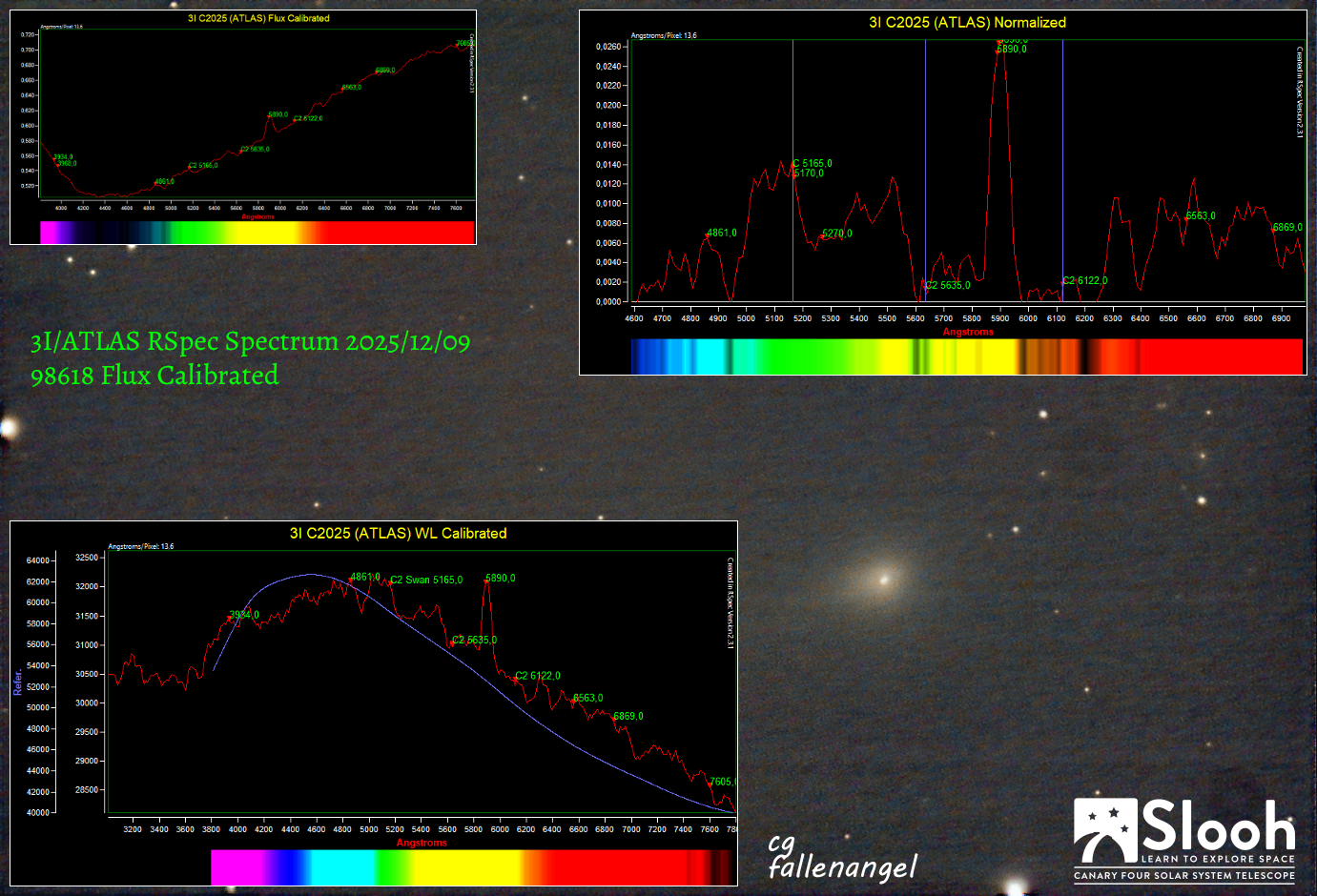
Wavelength (bot L) and Flux calibration (top L) with HD 98618 (G5V solar analog) and zero base normalization (top R).
CN Violet Band (3880 Å): STRONGLY DETECTED. Sharp, deep absorption-like feature at ~3880 Å is actually the telluric O₂ band. The CN emission is located right within this telluric feature.
C₃ Band (4050 Å): DETECTED. There is a distinct, broad emission bump centered around 4050 Å. This is hallmark of the C₃ molecule.
C₂ Swan Bands: VERY STRONGLY DETECTED. As in 11/29 spectrum, the Δv=0 sequence (~5700 Å) is the dominant feature. The Δv=-1 (~5165 Å) and +1 (~6190 Å) sequences are also clearly visible.
[O I] “Green Line” (6300 Å): DETECTED. A noticeable, sharp peak is present exactly at 6300 Å.
Red Dust Slope: EXTREMELY STRONG. The continuum rises steeply and continuously from ~4000 Å to a peak around 6600 Å. This indicates an even dustier coma than suggested by an earlier spectrum (see comet image). Read on comment.
🔭 Images captured using Slooh research-grade remote telescopes located in the Canary Islands, Chile, and Australia, processed with PI and RSpec.
© 2026 cgfallenangel All rights reserved.